Design research
How to research similar logos before finalizing a design
A search can reveal a familiar idea before it reaches the client. It cannot prove that a logo is legally clear.
The short answer
Search the name and visual idea in the relevant markets, compare similar uses, and record what you checked and when. Use image searches alongside descriptive searches and relevant trademark databases, not as a substitute for them. A designer’s visual research is not a legal clearance opinion; when rights or registration matter, involve a qualified trademark professional in the relevant jurisdiction.
1. Define what you are checking
A designer can independently draw a monogram and later discover that a similar one is already in use. Research cannot eliminate that possibility, but it can expose familiar combinations early enough to make a better design decision.
Start with the proposed name, principal symbol, words or letters, goods and services, current market and any planned expansion the client has shared. Confirm what is still confidential before uploading artwork to a search tool. Keep the agreed scope realistic: a small visual survey, a documented research pass and a professional clearance search are different services.
For this fictional example, North Room is a neighborhood workshop. Its draft symbol combines an open door with the letter N. The exercise below illustrates how to search; it is not a real clearance search or evidence that the example is available.
| Question | Useful action | What the result cannot establish |
|---|---|---|
| Is this concept visually familiar in its market? | Compare competitors and search descriptive terms for the motif. | That nobody uses a similar mark elsewhere. |
| Can I find similar-looking designs? | Use image search plus words, synonyms and trademark resources. | That search results are exhaustive or that a mark is safe to use. |
| Can the client use or register it? | Discuss a clearance search with a qualified trademark professional in relevant markets. | A designer’s research notes are not a legal opinion. |
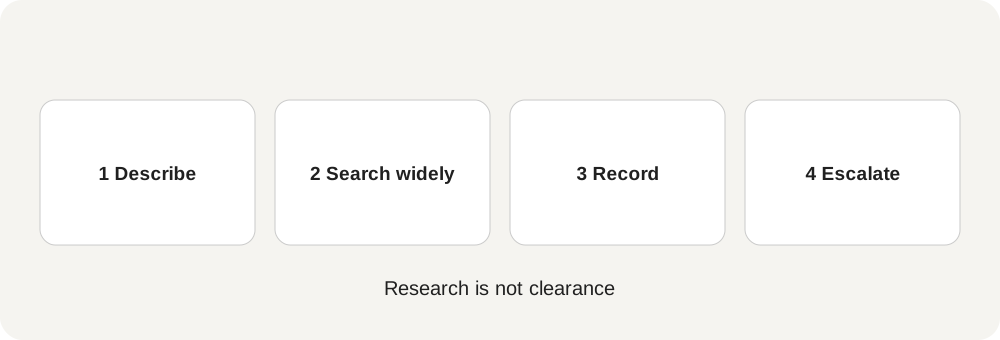
2. Map the market before searching the image
List direct competitors and adjacent businesses the audience may encounter. Search the business category plus the location, and inspect actual websites, storefronts and trade directories rather than relying only on inspiration boards. Note repeated conventions as well as close similarities. A door in a workshop category might be common even when no two marks are identical.
Search the proposed name and likely variants: spacing, spelling, pronunciation, translated meaning and meaningful abbreviations. A visual research pass is not limited to an exact name or one category. Record the territory and the goods or services you considered, and broaden the search if expansion is relevant.
Look at the entire identity in context, then separately compare the specific mark. Shared genre conventions alone do not prove copying or a legal conflict. Conversely, different colors do not automatically make two otherwise similar marks distinct.
3. Search the idea several ways
Describe the mark without the brand name: “letter N open doorway,” “door frame monogram,” or “negative space entrance symbol.” Try synonyms, alternative shapes and languages relevant to the audience. Search the full composition, then isolate the symbol and each prominent element. A single query or search engine has blind spots.
Where permission and confidentiality allow, use image search as a supplementary way to find leads. Search a clean crop of the mark and, if useful, a simplified variant. Review the source page and current context rather than treating a thumbnail or a similarity score as a conclusion. Do not upload confidential client work to a service without checking its terms and the project’s permissions.
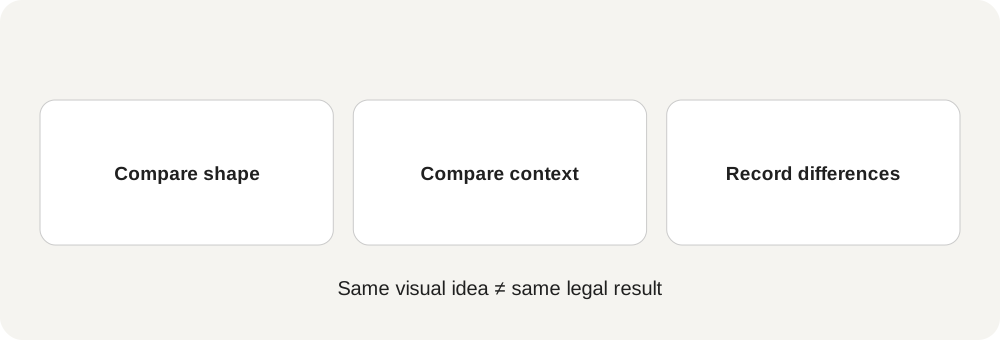
Save promising leads with links, access dates and short observations. For North Room, note whether the similarity is the idea of a doorway, the particular N-shaped geometry, the overall composition, or use in a related workshop. Record meaningful differences too.
4. Use trademark resources with their limits in view
Relevant registers can surface applications and registrations that an ordinary web search misses. WIPO’s Global Brand Database supports searching names, goods and services, and image similarity across its included collections. WIPO also recommends consulting national or regional registers because coverage and updates vary.
For US research, the USPTO documents search strategies for words and design codes; its search-system updates also describe a supplemental image search. Check the currently available interface and use more than one method. The USPTO explains that similar marks can look or sound alike, convey similar meanings or create a similar commercial impression, and that related goods or services need not share the same class.
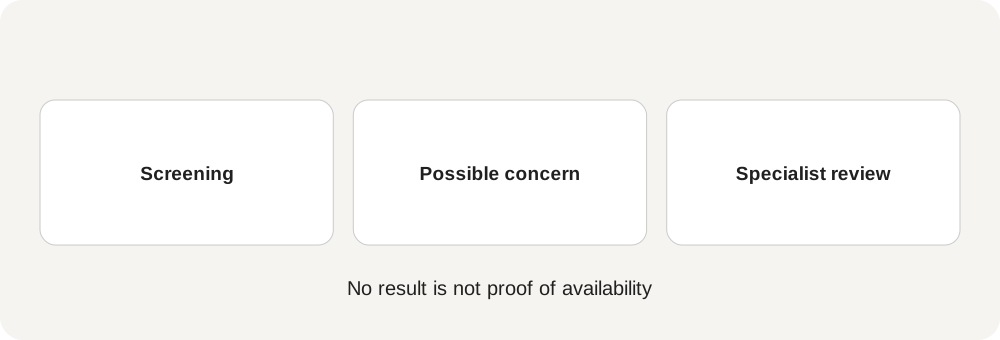
These are starting points for research, not a worldwide clearance recipe. A search result is a lead, not a legal finding. No result does not prove availability, and an older or inactive registry entry may still warrant professional attention depending on the circumstances. Local rules and records differ.
Further reading: WIPO: Global Brand Database and coverage · USPTO: federal trademark searching · USPTO: search system updates and supplemental image search
5. Compare observations without issuing a verdict
Put the proposed logo and each relevant finding side by side, with the source and context visible. Compare silhouette, letter structure, proportion, negative space, arrangement and overall impression. Then note the names, goods or services and markets associated with each finding. A close visual match outside the immediate category can still merit discussion; do not use a narrow class filter as a guarantee.
Distinguish a shared concept from a particularly similar execution. A generic doorway is not the same observation as matching distinctive angles and spacing. Equally, do not assume that changing color, mirroring a symbol or adding a word resolves a possible conflict.
If a finding raises a substantive concern, pause the affected direction, share the actual evidence with the client and recommend appropriate professional review. Avoid telling the client that a logo is “cleared,” “safe” or “unique worldwide” based on your search.
6. Document the search and decide what happens next
A concise research record lets the client and future reviewers see the work’s boundaries. Include the date, territories, relevant goods and services, exact queries, tools, selected findings and links, and what was not checked. Capture enough context to find a result again without reproducing another designer’s portfolio as your own work.
For North Room, a useful note might read: “Visual search on 4 November 2026 for doorway and N monograms among local workshops and adjacent education businesses. One visually similar composition found; link recorded. No legal clearance performed. Client to decide whether to request professional review before launch.” This is a fictional example, not a recommended legal conclusion.
If a direction needs redesign, return to the brief rather than making arbitrary cosmetic changes. Review the new direction again, keeping the research separate from the editable master and final handoff assets. If professional review is requested, supply the scope and findings rather than implying the reviewer is bound by your shortlist.
- The brief identifies the proposed name, mark, relevant markets and goods or services.
- I searched names, visual descriptions and image leads using more than one approach.
- I reviewed relevant competitors and considered related uses, not just identical matches.
- I checked permission and confidentiality before uploading any artwork.
- I recorded dates, sources, findings and the limits of the research.
- I did not represent the research as legal clearance or worldwide uniqueness.
- A qualified professional has been involved where the client needs legal advice or clearance.
Date and version: …
Name, motif and markets checked: …
Goods and services considered: …
Sources and queries: …
Findings and links: …
Limits or sources not checked: …
Next decision and owner: …
Further reading: USPTO: comprehensive clearance search
Common questions about logo similarity
The purpose of this workflow is to make design decisions more informed and to surface questions early. It does not determine another party’s rights or guarantee registration.
If reverse image search finds nothing, is the logo original?
A negative result means only that the particular search did not find a match. Indexes, query methods, territories and timing have limits. Search by description and relevant records too, and avoid guarantees.
Does finding a similar logo mean I copied it?
Not necessarily. Independent designers can arrive at similar ideas. Record the facts and context, discuss the concern with the client, and seek qualified advice when rights or use are in question.
Can two similar marks coexist if they are in different classes?
Do not assume so. In the US, for example, the USPTO explains that goods or services can be related even across different classes. The legal assessment depends on the facts and jurisdiction.
Can Logopack check trademark availability?
No. Logopack prepares and checks logo files for delivery; it is not a trademark clearance service. Use the appropriate official resources and consult a qualified professional when needed.
PUT IT INTO PRACTICE
Ready to prepare your pack?
logopack.app turns existing SVG artwork into an organized logo package. Preview your files, choose the available export options and check the result before handing it over. Exporting your own logo or icon files requires Pro.
Start with the logo pack generator, explore the sample ZIP, or compare the current plans.
Open generator